


ORGANIZATION CHART
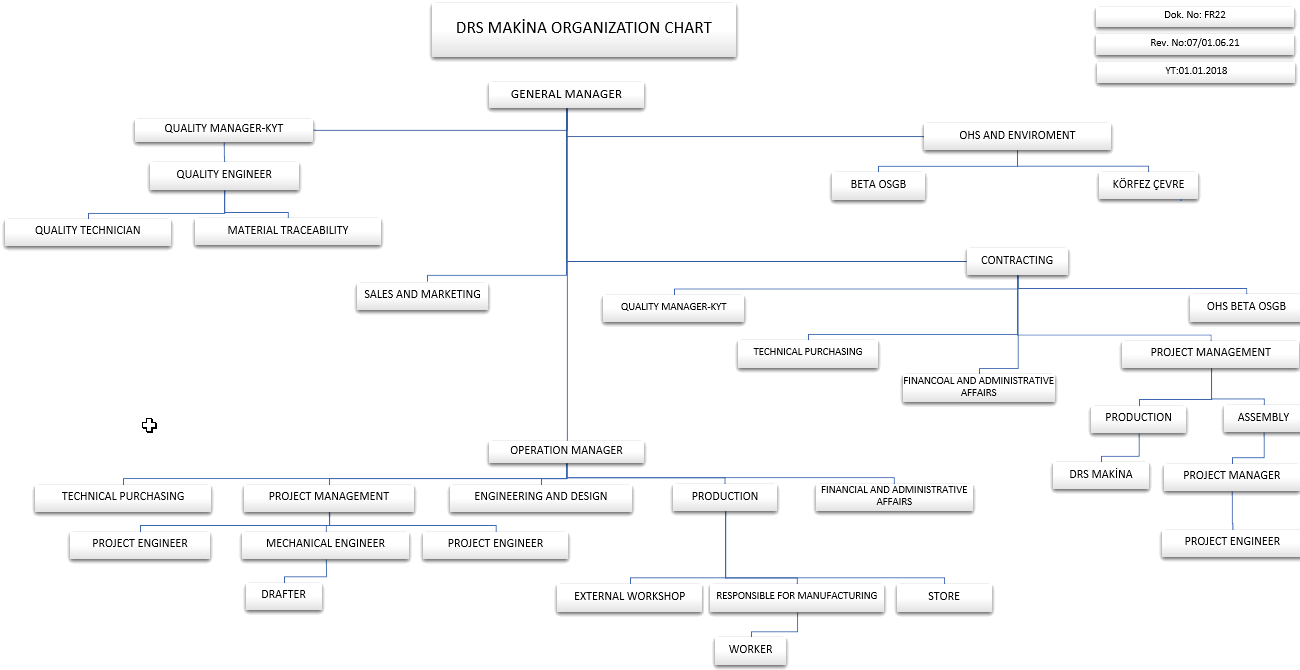
Located in our production facility at Kocaeli Dilovası İMES OSB, the industrial heartland of Turkey, manufacturing operations are conducted at international standards (ASME, API, EN, ISO) to meet the rigorous demands of the petrochemical, energy, food, and chemical industries. Shaped strictly in accordance with our corporate motto, “Where Engineering Meets Experience,” the DRS Makina Organizational Chart has been designed to ensure the flawless coordination of large-scale industrial plant installations, pressure vessel manufacturing, and heavy steel fabrication processes. All our departments operate within a highly integrated hierarchy based on uncompromising principles of maximum safety, engineering quality, and process traceability.
Quality Assurance and Material Traceability
Reporting directly to the General Manager, our Quality Management (Quality Manager-KYT) department is the guarantor of the independent execution of quality control processes within our production facility. Our Quality Engineering and Quality Technician cadres continuously audit operational compliance with ISO 9001:2015, ISO 3834-2 (Quality Requirements for Welding), and EN 1090 standards. Particularly critical for highly corrosive environments in the chemical and petrochemical sectors, the Material Traceability processes of carbon steels such as P235GH, P265GH, S355, and special stainless alloys like AISI 316L and 316Ti are rigorously recorded in accordance with EN 10204 3.1 certification requirements. Furthermore, non-destructive testing (NDT) operations, including hydrostatic testing, Radiographic Testing (RT), Ultrasonic Testing (UT), Penetrant Testing (PT), and Magnetic Particle Testing (MT), are executed under the absolute authority and supervision of this department.
The structural independence of the Quality Manager from the production schedule is a critical factor in maintaining our adherence to international norms. By reporting directly to the top management, the quality team possesses the full authority to halt operations if any deviation from the established WPS (Welding Procedure Specification) or dimensional tolerances is detected. This zero-compromise approach is what solidifies DRS Makina’s position as a reliable solution partner for critical infrastructure projects.
Engineering, Design, and Operation Management
Positioned at the center of manufacturing and field processes, the Operations Directorate (Operation Manager) coordinates the Technical Purchasing, Engineering, Production, and Project Management departments from a unified control point. Through our Engineering and Design department, static calculations and strength analyses are performed for process equipment and reactors in accordance with ASME Sec. VIII Div. 1 norms utilizing PV Elite software. Simultaneously, comprehensive 3D/2D detailed manufacturing drawings (including spool and isometric drawings) are prepared by Drafters via SolidWorks and AutoCAD. Our complex industrial solutions and Design processes are managed with strict engineering discipline, ensuring metallurgical integrity from raw material selection to the final stage of manufacturing.
Integrated within this structure, the Technical Purchasing department operates in full synchronization with Project Engineers to procure materials that strictly meet predefined specifications. Whether sourcing duplex stainless steels for specialized reactors or procuring S355 structural steel for heavy-duty pipe-racks, every item is subjected to rigorous incoming quality control, ensuring that material integrity is preserved long before any fabrication begins.
Production, Manufacturing, and Workshop Operations
Our Production unit operates with zero-defect tolerance by working in tight integration with internal supervisors (Responsible for Manufacturing), sub-contracted external workshops, storage facilities (Store), and expert technical staff (Worker). All welding operations applied during the fabrication phases—such as TIG (Argon), MIG/MAG, and Electrode Arc welding—are performed by our certified welding operators in strict accordance with project-specific approved WPS and PQR (Procedure Qualification Record) parameters.
This robust organizational structure enables DRS Makina to seamlessly transition from theoretical design to the physical realization of complex process equipment. Critical parameters, such as the precise application of heat treatments, acid passivation on AISI 304L stainless steel surfaces, or surface preparation procedures like sandblasting (achieving surface roughness values compliant with SA 2.5) followed by industrial epoxy coating, are executed flawlessly under continuous supervisory oversight.
Contracting, Field Installation, and Project Management
The management of industrial plant installations and turnkey projects is conducted under the umbrella of our Contracting department. This division undertakes highly critical field operations, including turnkey industrial piping, heavy steel structure assemblies, pipe-rack installations, and precise equipment placement driven by highly calculated lifting plans. Simultaneous projects executed in partnership with European-based EPC contractors and global technology developers are strategically planned by our Project Management department, led by Mechanical Engineers, and are meticulously tracked until the final commissioning phase.
Furthermore, our Sales and Marketing department ensures that these high-capacity operations are aligned with market demands, integrating our full spectrum of Services to deliver highly customized, client-oriented solutions for the energy generation, water treatment, and general industry sectors.
Occupational Health, Safety, and Environment Policy (OHS)
Operating with the profound responsibility of working within the highest risk classifications during heavy industry manufacturing and planned shutdown services, our OHS and Environment department collaborates with certified expert partners such as Beta OSGB and Körfez Çevre. From in-factory fabrication cycles to complex field assemblies, operational safety is maintained at the absolute maximum level by adhering strictly to the “Zero Occupational Accidents” principle at every procedural step.